
Imagine you’re on a Friday evening in New York, about to migrate a dollar-value position across a DEX, when a popup asks you to “sign” a transaction that will drain approvals you forgot you gave six months ago. The UI is minimal, gas looks normal, and the contract name is plausible. You hit confirm — and the rest is an ugly lab exercise in emergency revocation and customer support tickets.
That scenario has become painfully familiar in DeFi, particularly for US-based power users who shift assets across chains and aggressive dApps. The root problem isn’t always malice: it’s opacity. A signed transaction encodes low-level operations that are hard for a human to read, and traditional wallets have left users with an all-or-nothing decision. Transaction simulation — the act of running a proposed transaction in a safe, read-only environment and showing the user its expected effects — tries to change that decision from blind faith into informed consent.
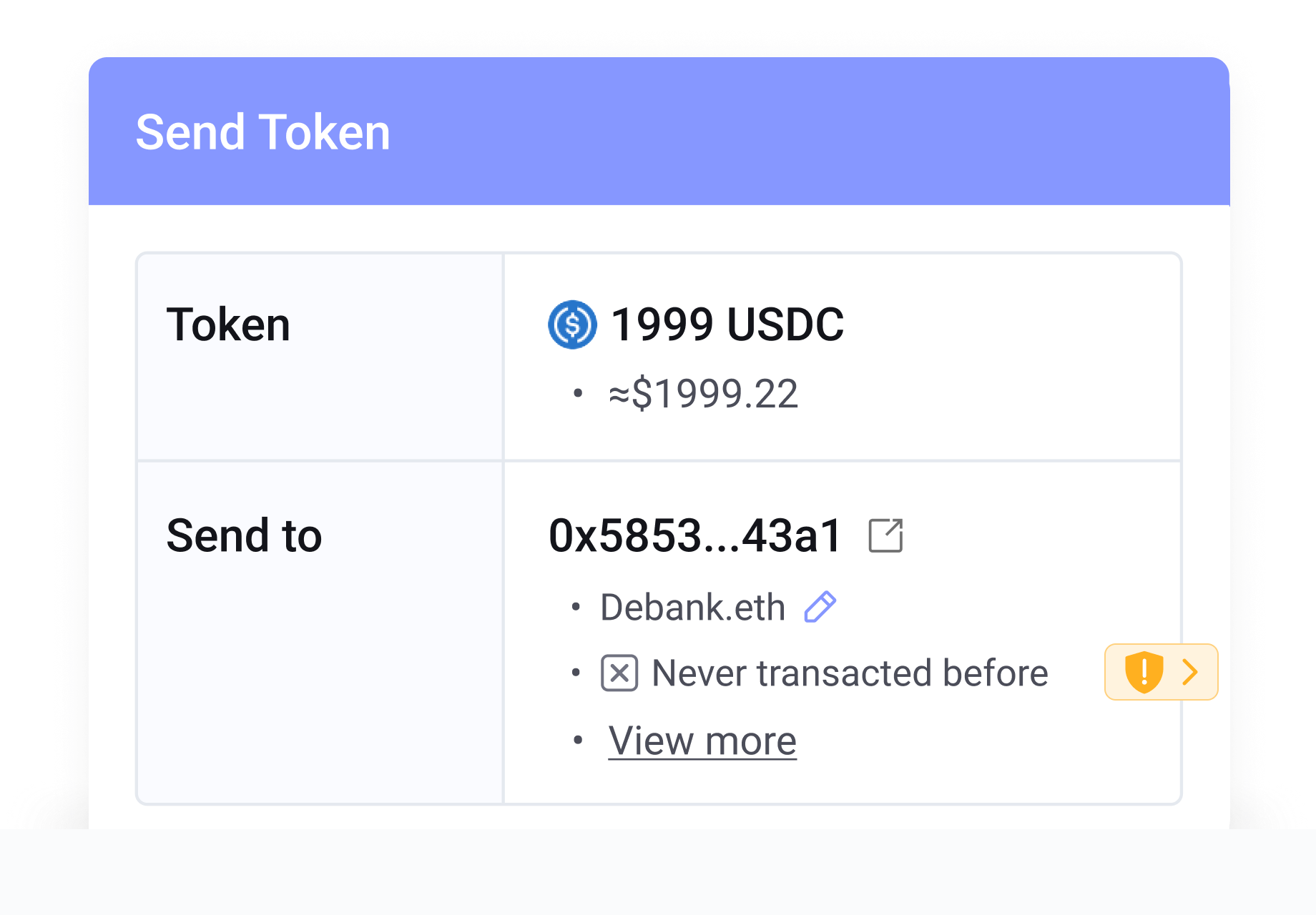
How transaction simulation actually works (mechanism, not marketing)
At the protocol level, a transaction is a sequence of calls and state changes. Simulation takes that raw transaction, invokes the same contract code in a node or sandboxed EVM without broadcasting it, and inspects the resulting state transitions. A useful simulation translates low-level changes into human-readable effects: token debits and credits, leftover approvals, slippage, and gas burned. It also isolates edge cases — for instance, whether a transfer will fail because of insufficient allowance, or whether a single call triggers a second delegatecall into a third-party contract.
Rabby Wallet integrates this mechanism into the signing flow. Before you sign, its engine runs a pre-transaction risk scan, flags previously hacked contracts, warns on suspicious approval requests, and shows the exact estimated token balance changes and fee costs. That removes the smoke screen. Instead of “Do you want to sign?”, the user sees “If you sign, you will lose X tokens, gas will be Y, and this contract has N previous security flags.”
Why simulation matters for multi-chain power users
Power users are not just transacting more; they combine primitives — swaps, liquidity migrations, cross-chain bridges — in one flow. That composability increases surface area for mistakes and exploits. Simulation addresses three concrete risks:
1) Blind signing of approvals: Many exploits begin with an unrestricted approval (ERC-20 approve max). Simulation reveals whether a transaction will set or use such approvals and whether it will change allowances elsewhere, making the risk visible before signing.
2) Unexpected balance movements: A swap that seems like 0.1 ETH for token A could be routed differently or contain an extra transfer. Seeing the predicted token balance deltas lets users catch routing surprises or sandwich-prone orders.
3) Cross-chain nuance: Rabby’s cross-chain gas top-up and automatic network switching reduce friction when moving between L1 and L2s, but moving liquidity across chains still involves gas, wrapping, and bridge escrow steps. Simulation makes these chained costs and transfers explicit, so you don’t trigger a bridge without the necessary gas on the destination chain.
Trade-offs and limits: what simulation can and cannot do
Simulation is powerful but not omnipotent. It depends on three fragile pieces: an accurate node state, honest contract bytecode, and deterministic execution paths. If a contract reads off-chain data (oracles), depends on later block state, or includes time-based randomness, simulation will produce an estimate that can differ from on-chain reality. Likewise, simulations run against a node’s mempool snapshot; front-running and miner-extracted value (MEV) can change the eventual outcome.
Rabby’s engine mitigates some of this by showing estimated fee costs and by flagging known-hacked contracts, but it cannot prevent every MEV sandwich or guarantee that an off-chain oracle won’t change before the transaction lands. Also, simulation doesn’t replace good hygiene: Rabby lacks a fiat on-ramp and native in-wallet staking, so users still face the usual custody and liquidity trade-offs when acquiring assets or seeking yield.
Design choices that matter to power users
When choosing a wallet for heavy DeFi use, evaluate these dimensions rather than marketing slogans:
– Integration with hardware and multi-sig: For large holdings, hardware devices (Ledger, Trezor) and multi-sig guards (Gnosis Safe) reduce single-key failure. Rabby supports a broad set of hardware wallets and integrates with institutional tools — a practical plus for US traders managing regulatory scrutiny or treasury rules.
– Revocation and approvals UX: It’s not enough to detect bad approvals; you must be able to revoke them quickly. Rabby’s built-in approval revocation tool streamlines this step, lowering the window of exposure after a suspicious event.
– Automatic network switching vs. user control: Auto-switching to the network a dApp needs reduces click friction and mis-signed attempts on the wrong chain. But automation can mask which chain a dApp will operate on; power users should check the simulation details to confirm the intended network and gas token.
Past incidents and trust calculus
Security histories matter. Rabby experienced a 2022 smart-contract exploit associated with Rabby Swap, with roughly $190,000 lost. The response — freezing the contract, compensating users, and expanding audits — is a non-trivial signal about incident response maturity. But history is not destiny; it shows risk and the team’s willingness to remediate. Open-source code under the MIT license helps independent auditors examine the codebase, yet open source alone is not a proof of safety.
For US users, that calculus includes regulatory and institutional expectations: audit trails, integrations with custody services, and the ability to use multi-sig workflows. Rabby’s institutional integrations and wide platform support (extension, mobile, desktop) align with those needs, but organizations should still perform their own due diligence and possibly run independent audits for any custom contracts they use.
Common myths vs. reality
Myth: “If a wallet simulates transactions, I can never be exploited.” Reality: Simulation reduces a class of human-agreement risks but doesn’t remove on-chain economic attacks like MEV, oracles flipping, or social-engineered approvals.
Myth: “Open-source equals secure.” Reality: Open source enables independent review but relies on active audits and a security program to be meaningful. A codebase unseen by qualified auditors or left unupdated still carries risk.
Myth: “Automatic network switching is always safer.” Reality: It reduces user error but can hide which chain a transaction will execute on; always inspect the simulated network context before signing.
Decision-useful heuristics for DeFi power users
– Treat simulation outputs as primary evidence: When a wallet shows exact balance deltas and fee estimates, use those figures to reconcile against your intended trade. Mismatch = abort and investigate.
– Combine layers: Use hardware wallets + transaction simulation + approval revocation. Individually each reduces risk; together they create a practical defense-in-depth.
– Keep an incident playbook: If a simulation reveals an unintended approval or transfer, immediate steps are: revoke approval, move unaffected assets to cold storage, and snapshot transaction data for any custodian or insurer claim.
What to watch next
From a near-term perspective, watch how wallets improve simulation fidelity around MEV and oracle-dependent operations. Tools that combine mempool-aware simulation and predictive front-run risk scoring could materially reduce value extraction attacks, but they require colocated infrastructure and constant data feeds — a cost and design trade-off for wallet teams. Also monitor how regulators in the US treat non-custodial services: transparency, mandatory disclosures, or audit requirements could change product priorities.
Finally, usability will remain decisive. Simulation offers clarity, but if it becomes noisy or false-positive heavy, users will bypass it. The balance between minimizing false alarms and catching real threats is a product design problem with real security consequences.
For readers who want to try a wallet that combines transaction simulation, automatic network switching, and approval revocation while supporting hardware wallets and institutional integrations, consider exploring the implementation and UX directly via the project’s public pages for practical familiarization with the flow: rabby wallet.
FAQ
How accurate are transaction simulations in practice?
Simulations are generally accurate for deterministic, on-chain-only logic where the contract does not rely on external oracles or later block state. They are less reliable when off-chain data, miner manipulation, or race conditions can change execution. Treat simulations as strong indicators, not guarantees.
Can simulation prevent MEV or front-running?
No — simulation can reveal whether a transaction is a profitable target by showing expected deltas and fees, but it cannot stop others from inserting transactions into the mempool. Mitigations include private mempools, gas strategies, and specialized relayers — functionalities typically outside the scope of a wallet’s basic simulation.
Does Rabby replace hardware wallets or multisig?
No. Rabby complements those tools by providing clearer signing decisions and revocation tools. For large sums, hardware wallets and multi-sig remain essential layers of security.
Is automatic network switching a privacy risk?
Automatic switching exposes which chain a dApp needs to the wallet, but it does not, by itself, leak transaction content. The bigger privacy questions are about metadata and connected sites; power users should pair auto-switching with cautious site permissions and revocation hygiene.